
 Naijacentral Naijacentral
Four scholars residing in Enugu have hailed the continuation of governorship zoning system that has ensured peace and stability within Enugu State from 1999 till date.
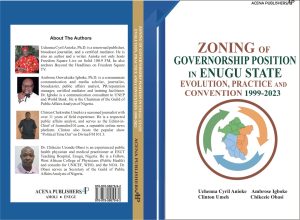
Speaking during a pre-unveiling press briefing in Enugu on the book titled:“Zoning of Governorship Position in Enugu State: Evolution, Practice and Convention (1999–2023)”, the co-authors said that they wanted to provoke discussion on zoning arrangement that works.
The co-authors – Dr Uchenna Anioke, Dr Ambrose Igboke, Mr Clinton Umeh and Dr Chikezie Obasi — noted that the book is scheduled for public presentation on May 7, 2026 at the International Conference Centre, Enugu.
They said that the new book examined the evolution, practice, and conventions surrounding the zoning of the governorship position in Enugu State in all ramifications.
The co-authors noted that they were motivated to embark on the publication to present an empirical, fact-based and research-driven effort, which documented and clarify the often debated zoning arrangement in Enugu State politics.
Speaking, Dr Uchenna Anioke, one of the co-authors, said that the outcome of the 2023 governorship election, which witnessed intense debate and disagreements over zoning, remained a major push for the work.
He noted that former Gov. Ifeanyi Ugwuanyi strongly upheld the zoning principle, adding: “Ugwuanyi’s stance may have cost him a political Fortune”.
Anioke emphasised that zoning had remained an issue in every election cycle, but stakeholders interviewed for the book overwhelmingly agreed that the system—whether viewed as a convention or practice — had worked for Enugu State.
Describing the book as a blend of historical documentation and eyewitness accounts, he traced the roots of zoning to what he called a “triangular equilibrium” among the old Enugu, Nsukka, and Abakaliki divisions.
This, he explained, served as a balancing mechanism before the creation of new states and the current 4th Republic.
According to him, the book captured the general consensus among the people that equity and fairness are best preserved when power rotates among the zones.
Corroborating, another co-author, Dr Ambrose Igboke, said that the publication situates zoning within the framework of senatorial district balancing rather than cultural considerations.
Igboke said that the authors relied on archival records and firsthand interviews with key political players still alive, adding: “This is our contribution to knowledge.”
He added that the book provides an exhaustive account of developments from 1999 to 2023, including insights into how zoning influenced not just the governorship but also other offices such as deputy governor and speaker.
Speaking, another co-author, Mr Clinton Umeh, revealed that the book uncovered political intrigues dating back to 1999, among former Governor of old Anambra State, Sen. Jim Nwobodo, former Gov. Okwy Nwodo, and late former Gov. Christian Onoh.
The co-author said that the three prominent political leaders and their followers debated vehemently which zone should produce the first governor in the new democratic era (current 4th Republic).
Umeh noted that the book also explored the political dynamics that contributed to former Gov. Chimaroke Nnamani’s emergence as governor in 1999.
He also said the book dealt on issues such as the unique case of Isi-Uzo Local Government Area, which council area stands admixt both unique cultural and political identities of Nsukka Cultural Zone and Enugu East Senatorial Zone.
Umeh, however, noted that zoning had contributed significantly to political stability and enduring political peace in Enugu State.
In his views, Dr Chikezie Obasi, one of the co-authors, said that current governorship zoning system had removed bitter political rancour and volatility from the state.
Obasi said that states “where zoning for equity does not exist” there would be continuous strive and volatility even after a governor had emerged lasting up to four years.
He described the book as the first comprehensive scholarly attempt to validate the zoning arrangement in Enugu State.
He noted that zoning had help reduced political tensions from the time of political primaries, as major political parties respect the zoning convention.
The authors collectively expressed confidence that the book would deepen understanding of Enugu State politics for researchers and help prevent future disputes since the zoning system and structure had been upheld by all.
For Advert placement, music promotion, event coverage, social media & event management, or to share breaking news story with us, contact: +2348134740033