
 Naijacentral Naijacentral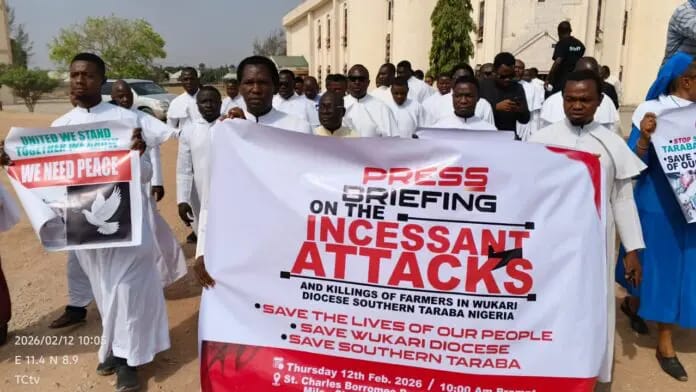
Guess writer
A new report by the International Society for Civil Liberties and Rule of Law (InterSociety) is raising fresh concerns about escalating religiously linked violence across parts of Africa, with Nigeria, the Democratic Republic of the Congo (DRC), and Ethiopia identified as critical flashpoints.
The civil rights group says its long-term monitoring of killings, abductions, and destruction of places of worship suggests that insecurity across sub-Saharan Africa is not only persistent but spreading in scale and geographic reach.
A Continent Under Pressure
According to InterSociety, Africa is home to an estimated 750 million Christians — roughly half of the continent’s 1.5 billion population. The report argues that armed extremist groups operating across the Sahel, Central Africa and parts of East Africa have intensified attacks on civilian populations over the past decade.
The countries identified as most vulnerable include:
* Nigeria
* Democratic Republic of the Congo
* Ethiopia
Together, these three nations account for nearly 300 million Christians.
In eastern DRC, the Allied Democratic Forces (ADF) — an armed group with reported links to ISIS networks — has been blamed for repeated massacres of villagers and attacks on churches. In Ethiopia, Al-Shabaab fighters based in Somalia have launched cross-border incursions into border towns. Across the Sahel, insurgent groups affiliated with ISIS and Al-Qaeda continue to expand their operational zones.
InterSociety contends that these overlapping insurgencies are reshaping security dynamics in Christian-majority regions of Central and Eastern Africa.
Nigeria: Epicenter of the Crisis
The report places particular emphasis on Nigeria, describing the country as hosting one of the largest concentrations of armed extremist groups on the continent.
Covering July 2009 to February 2026, InterSociety estimates:
* 189,300 civilians killed
* 130,000 abducted
* 19,500 churches attacked, destroyed or forcibly closed
For 2025 alone, the organization reports 7,500 Christian deaths and 8,500 abductions — figures significantly higher than some international watchdog estimates. In the first 55 days of 2026, the group documented 1,120 killings and 1,640 abductions affecting both Christians and Muslims.
The violence, it says, spans Nigeria’s six geopolitical zones, with North-Central, North-East and North-West regions most severely affected.
Nigeria has battled insurgency since Boko Haram launched its armed rebellion in 2009. Over the years, splinter groups such as ISWAP emerged, while banditry and farmer–herder conflicts intensified in parts of the North-West and North-Central. Security analysts often describe the crisis as multi-layered — blending ideology, resource competition, criminal enterprise and governance failures.
Displacement and Demographic Impact
InterSociety estimates that approximately 10 million people have been internally displaced over the years, with millions living outside formal camps in urban areas or with relatives. Official government figures are lower, reflecting long-standing discrepancies between state and independent reporting.
The report also highlights:
* Widespread destruction of rural communities
* Seizure or abandonment of farmland
* Repeated attacks on clergy and faith leaders
* Large-scale movement of populations from hinterland areas to urban centers
In Plateau, Benue, Kaduna and Borno states, recurring cycles of attack and reprisal have deepened mistrust between communities and placed enormous pressure on local economies.
Data Disputes and Political Sensitivities
Conflict casualty figures in Nigeria and across Africa remain highly contested. Government agencies, international NGOs and local advocacy groups often publish different numbers, reflecting challenges in access, verification and classification of motive.
While InterSociety frames much of the violence in religious terms, other analysts argue that many attacks are driven by complex blends of ethnicity, land competition, climate stress and criminal opportunism, rather than purely religious ideology.
Security experts caution that oversimplifying motivations risks obscuring broader structural drivers of conflict — including poverty, weak state presence in rural communities, porous borders and proliferation of small arms.
A Regional Security Test
Beyond Nigeria, the report warns that instability in the Sahel and Central Africa is creating ripple effects across neighboring states. Burkina Faso, Mozambique, parts of Sudan and regions around Lake Chad continue to experience insurgent violence and mass displacement.
International monitoring bodies such as Open Doors and other faith-based watchdogs have also documented rising persecution levels in multiple African countries, underscoring the continent’s growing role in global religious freedom debates.
The Road Ahead
InterSociety concludes that without strengthened regional security cooperation, improved intelligence coordination, effective rural policing and expanded humanitarian response systems, large swathes of vulnerable communities may remain exposed.
The report calls for:
* Enhanced protection for civilian populations
* Transparent casualty documentation
* Greater interfaith dialogue
* Stronger governance reforms in conflict-prone regions
Whether or not all stakeholders agree on the numbers, the broader reality is harder to dispute: insecurity across large parts of sub-Saharan Africa continues to claim lives, uproot families and strain fragile institutions.
As governments across the continent confront insurgencies, economic pressures and political transitions, the challenge remains how to balance security enforcement with long-term peacebuilding — and how to ensure that vulnerable communities, regardless of faith, are protected.
For Advert placement, music promotion, event coverage, social media & event management, or to share breaking news story with us, contact: +2348134740033