
 Naijacentral Naijacentral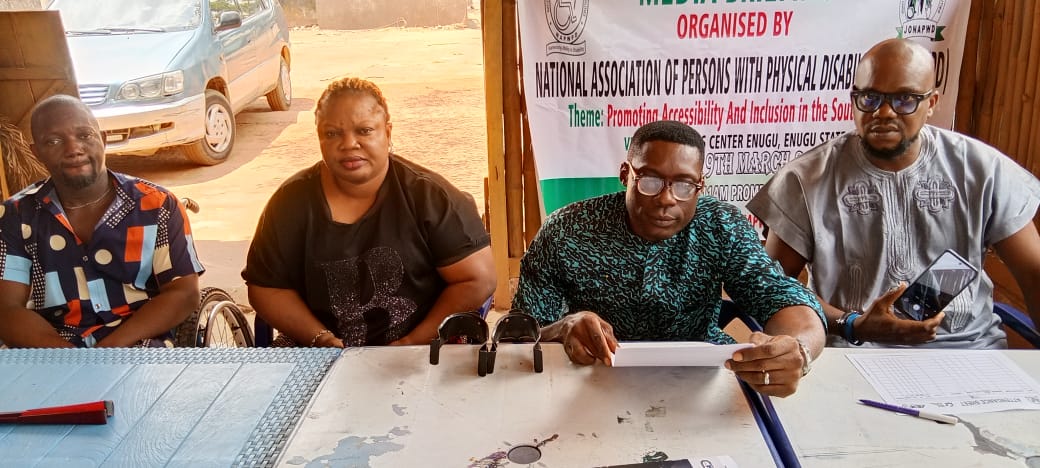
By Naijacentral
The National Association of Persons with Physical Disabilities (NAPWPD) and in partnership with civil society organizations of Onyekachukwu women empowerment foundation have raised concerns over persistent barriers and discriminatory treatment faced by the persons with physical disabilities across the South-East region.
The Advocacy Lead, NAPWPD, Anambra State, Comrade Ugochukwu Okeke, stated this on Thursday during a news conference organised by the South-East chapter of the association in Enugu.
The event, which had the theme, “Promoting Accessibility and Inclusion in the South-East Region,” aimed at drawing attention to the challenges confronting persons with physical disabilities (PWDs) and advocating inclusive policies.
Okeke said that the programme was sponsored by the Joint National Association of Persons with Disabilities (JONAPWD) to strengthen advocacy for accessibility in the region.
He stressed the critical role of the media in shaping public opinion and influencing policy, urging journalists to amplify issues affecting vulnerable groups, particularly persons with disabilities.
“Thousands of PWDs in the South-East continue to face daily obstacles that limit their ability to live, work and participate fully in society.
“These challenges stem not from the disabilities themselves, but from environmental, structural and systemic shortcomings,” he said.
Okeke identified three major areas of concern – inaccessible public infrastructure, inadequate transportation systems and poor enforcement of disability laws.
He lamented that many public buildings including government offices, schools, hospitals, banks, and markets lacked basic accessibility features such as ramps, elevators and accessible restrooms.
This, he said, often prevented persons with disabilities from accessing essential services
Transportation, he added, remained another major hurdle, as most public and commercial vehicles were not designed to accommodate wheelchair users or individuals with mobility challenges.
This limitation, he noted, affected access to education, healthcare and employment opportunities.
Okeke equally highlighted the gap between legislation and implementation, referencing the Discrimination Against Persons with Disabilities (Prohibition) Act enacted in 2018.
He said the law mandated accessibility and prohibited discrimination, but regretted that compliance remained low across the region due to poor awareness and enforcement.
“We call on media organisations to play more active roles by increasing coverage of disability issues, conducting investigative reports on accessibility compliance and promoting public awareness of disability rights,” he said.
Okeke further urged media platforms to adopt inclusive practices such as sign language interpretation and to provide opportunities for persons with disabilities to share their experiences directly.
He expressed optimism that with stronger collaboration among stakeholders—including government, private sector, civil society, and the media—the South-East could become a model for disability inclusion in Nigeria.
speaking , the civil society organization working with (JONAPWD ) Virginia Obianyo, noted that the law was passed in the year 2023 stating that she has been emphasizing on the law the need to implement it .
“ this law was passed 2023 , April precisely in Enugu and since then I have been going to communities emphasizing on the law “
Obianyo, encouraged the persons with disabilities to monitor the implementation of the law. Adding that there’s need to consider persons with disabilities while building public structures for commercial purposes.
“If you are currently building a public houses , individual houses you have to put this people into consideration because they are there in your community they are there in the states“
“ let’s us we the civil society organizations in partnership with JONAPWD to monitor the implementation of whatever the government is doing”